

Remembering Old Atoka
A look back at the people, places, and memories
that shaped our hometown
Every town has a story. Atoka, Tennessee’s history is about hard work, strong families, and community spirit. From its early days to the vibrant town it is today, Atoka’s history is filled with remarkable people and unforgettable moments.
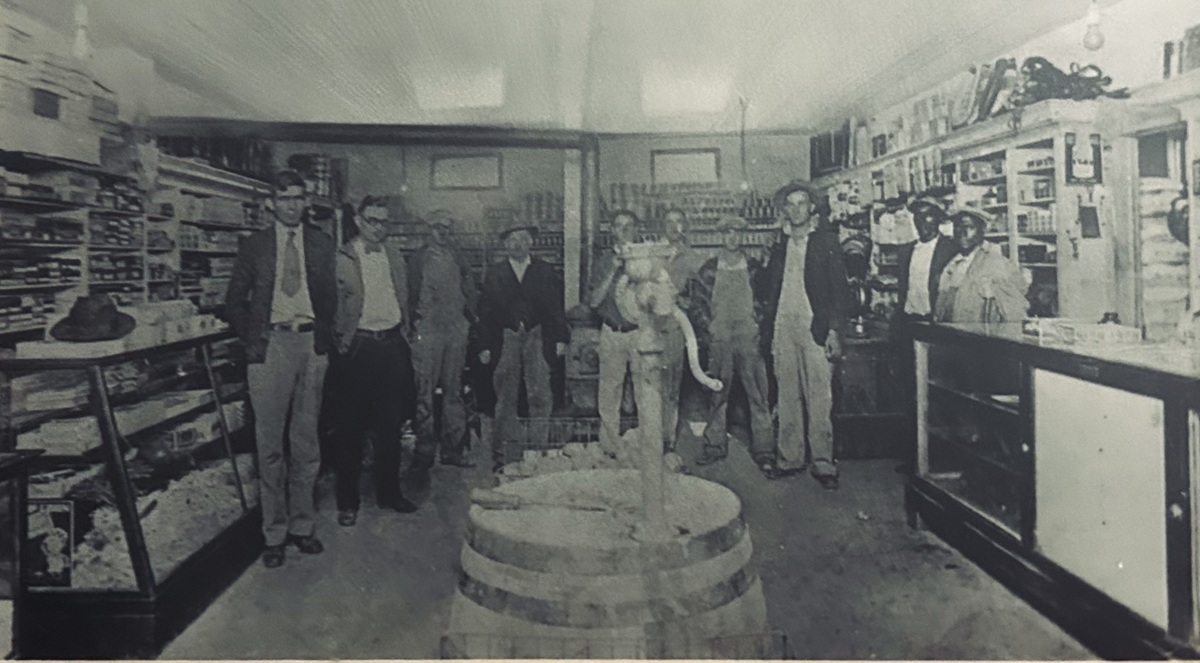
Drive through Atoka today, and you’ll see one of the fastest-growing towns in Tipton County: subdivisions, ball fields, new businesses. More than 10,000 people called Atoka home at the last census, making it the largest town in the county. It’s a good place. But underneath the new Atoka is an older one — a small railroad town of cotton, lumber, and front-porch neighbors. We should record that Atoka while the people who remember it are still here.
This is the first story in what I hope becomes a real collection of Atoka history on Honor Sphere. Some of what follows comes from published histories and records. Different people handed down some of the stories. I’ll try to be clear about which is which, the same way I’d want it told to me.
A Name Carried from Far Away
Every story about Atoka starts with its name, because the name itself is a piece of history that traveled.
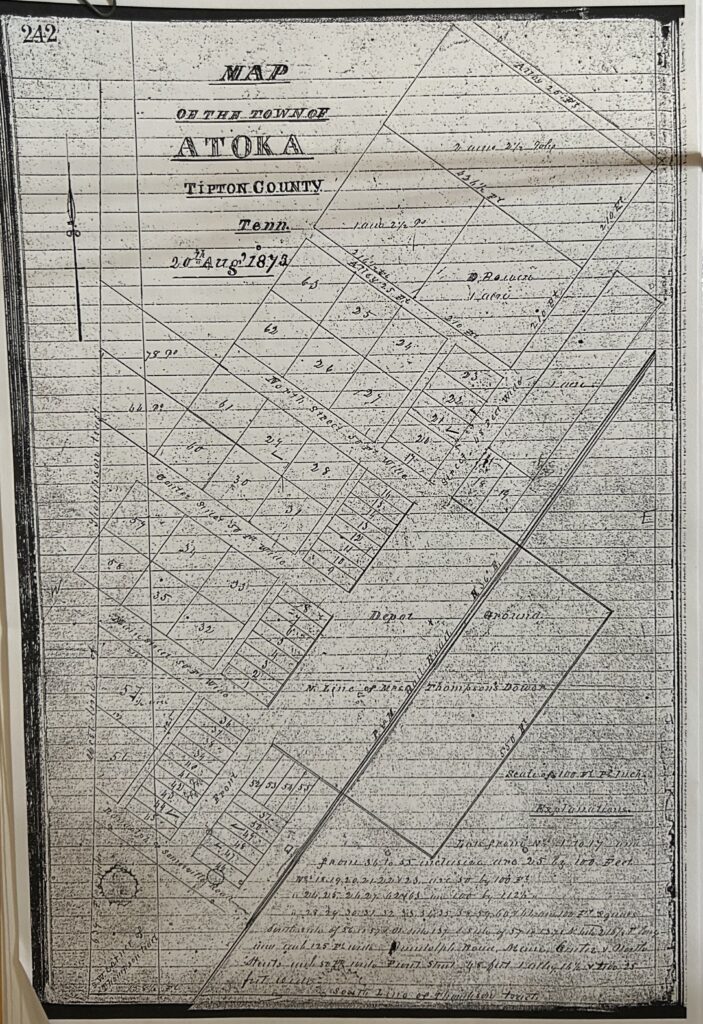
“Atoka” comes from the Choctaw word hitaka – sometimes spelled hetoka – meaning “ball ground,” the field for stickball. When the founders laid out the new railroad town in 1873, they chose the old Choctaw word Atoka for it. The name had already traveled a long way before it ever got to Tennessee. It became official on March 24, 1875, when Atoka adopted Portersville’s town charter. The picture above is a copy of the “Map of the Town of Atoka, Tipton County, Tenn., 20th Aug’ 1873”. The map came from land records at the Tipton County Courthouse.
You will also hear the name associated with Captain Atoka, a Choctaw leader of the Pushmataha District. His name came from that same word. That story is well documented for Atoka, Oklahoma, founded in the 1850s. The people of Atoka, Oklahoma, named their town and their county for Captain Atoka, who signed the Treaty of Dancing Rabbit Creek. This gets repeated for our Atoka too. Whether our founders named the town for the man or for the word itself, the local histories do not settle — so I will give you the part they do agree on: the word, and what it meant.
Before there was an Atoka, though, there was somewhere else entirely.
Before Atoka, There Was Portersville
The older settlement in this story is Portersville, a few miles east of present-day Atoka, near the Salem community, which contains Salem ARP (Associate Reformed Presbyterian) Church and the Salem ARP Cemetery. Portersville was established in the early 1830s. Local histories name James Hodges as one of the founders of Portersville. It was incorporated on January 17, 1838. Many early settlers were immigrants from Ireland who landed in Chester, South Carolina. This means some of the first families here were already travelers when they arrived, carrying their original country’s traditions and culture with them. Today there is a road named Portersville, but nothing of the old community remains.
For decades, Portersville was the place that mattered in this part of Tipton County. It had the stores, the commerce, the future — right up until the future changed its mind and arrived on rails, three miles west.
The Railroad Decided

In 1872, the Memphis and Paducah Railroad laid its tracks through land owned by Hugh Thompson, about halfway between Mt. Zion (now Munford) and Portersville. A new town grew up at the tracks, the way towns did then, because the tracks were where the money moved. Atoka quickly became the shipping point for the cotton and lumber of the surrounding countryside.
What followed was a rivalry, the kind old-timers used to tell about with some relish. Portersville had the head start and the established businesses. Atoka had the railroad. It wasn’t a fair fight. Commerce drained west to the depot, store by store, until Portersville gradually faded away to a community and a memory.
The paperwork tells the same story. On March 24, 1875, Portersville’s name was changed to Atoka, and the new town took up the older town’s 1838 charter as its own. That first charter didn’t last — it was repealed in 1883 — and Atoka was reincorporated on June 24, 1911. By 1888, the town was a stop on the Newport News and Mississippi Valley Railroad, and trains have been part of Atoka’s soundscape ever since. They still are: the City of New Orleans passes through daily on its run between Chicago and New Orleans, and on a quiet night you can hear the railroad doing what it has done here for more than 150 years — connecting this small place to everywhere else.
The Post Office Followed the Railroad
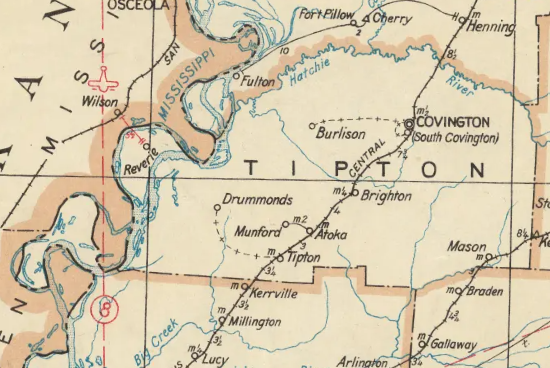
Over the years, I’ve heard many stories of how the mail was delivered to the Atoka Post Office by train. The train didn’t stop. The mail was released onto a hook as the mail train passed by. I don’t have anything to confirm that at the moment, but I always found this fascinating.
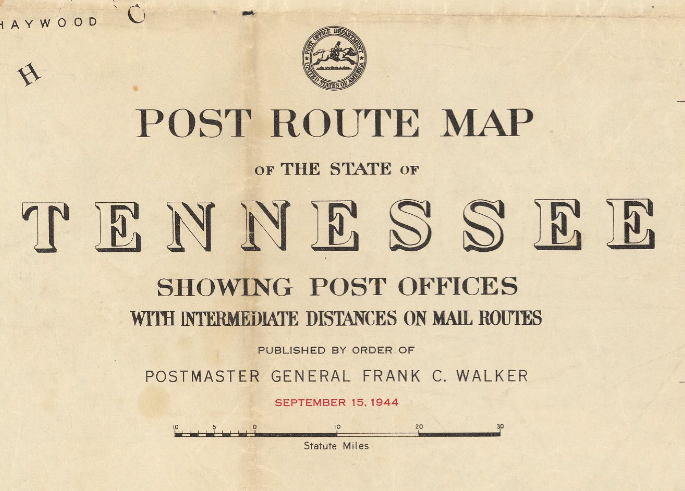
What I do have is a map created by the United States Postal Service, dated September 15, 1944, showing mail drop areas along railroad routes in Tennessee. The Post Office and the railroad played a huge part in the development of Atoka, Tennessee.
The Atoka I Remember
From Birth
I was born in a hospital in Memphis, Tennessee, and came home to live next to my paternal grandparents in the second house on the East side of the railroad track and the north side of the road. It was one of my Grandpa Walker’s rental houses. We only lived there a few years, but I remember playing in the privet hedge between our house and the next house to the east of us. Mother planted a mimosa tree on the west side of our house. We called it the “monkey tree” because it was so easy to climb. We spent a lot of time rolling down the hill between our house and our grandparents’ house.
A New Home
But it wasn’t long before we moved into a new home north of what was then Atoka. We lived outside of Atoka until the Atoka Board of Mayor and Aldermen took the land we lived on into the city limits. Atoka provided very few amenities back then. The roads were taken care of, but we had well water and our own septic tank. There were no street lights or city parks, but we had lots of space to play on the land where we live.
Churches
I remember going to the store in Atoka occasionally. But every Sunday we went to church at Atoka Presbyterian Church. I later learned that my Dad’s family had gone to that church since before it moved from Portersville to Atoka. In the summer, we went to Bible School at either Atoka Presbyterian or Atoka Methodist. Those two churches took turns having Bible School – one took care of it one year, the other the next. We also went to a second Bible School each year at Salem ARP Church. I always thought Salem was such a pretty church.
A Long Life & A Growing Town
I’ve lived here all my life, except when I went off to school. I met my husband in Memphis. We lived in Chattanooga a little while before moving back to Atoka to stay in 1980. I’m not very young now, so I have lots of memories of Atoka. In my lifetime, Atoka grew from a town of about 300 people to the largest community in Tipton County with over 10,000 people.
Developing an Interest in History
Two different events fed my own interest in the history of Atoka. The first was when I helped with Atoka’s Tennessee Homecoming ’86 Celebration. That event sparked a lot of interest in Atoka’s history. The community worked together quite well. A lasting memory came out of that experience – a book called “Welcome Home Atoka! A History of Our Town.” Not reprinted since 1986, this book is kept as a family heirloom by many of the older families.
The second event that sparked my interest in the history of Atoka was when a member of our family, Jimmy Walker or Cousin Jimmy from Covington, gave me copies of his family research, our family, and my family.
I later used information from both of these events to help put together my family history so I could join the Daughters of the American Revolution. A woman from the Millington chapter found the missing information I needed to connect the dots. I served many years as a volunteer with the River City Chapter of the Daughters of the American Revolution and the Tennessee Society of the Daughters of the American Revolution. The ladies in that chapter and state society taught me more than I could ever have learned on my own. And they were not easy on me – much of that volunteer service was very hard work that I thoroughly enjoyed. It was an amazing experience. Since serving with them, I have tried to become more involved with the Atoka community and discover what I missed here while I was volunteering elsewhere.
Why Remember
Atoka’s population was 659 people in 1990. Read that again. Within one generation, a town of
hundreds became a town of thousands, and that growth is something to be glad about — it
means people want to live here. But growth has a cost that never shows up on a census form:
every new subdivision sits on land somebody’s grandfather farmed, and every renamed road had an older name that somebody’s grandmother used in her directions.
Old Atoka isn’t gone. It’s underneath — in the railroad line, in the Salem and Portersville ground to the east, in family Bibles and photograph albums and the stories that start with “I remember when.” Someone is going to wonder where they come from. When they do, I want some of it written down and waiting for them.
If you remember something about old Atoka that belongs in this story — a person, a place, a
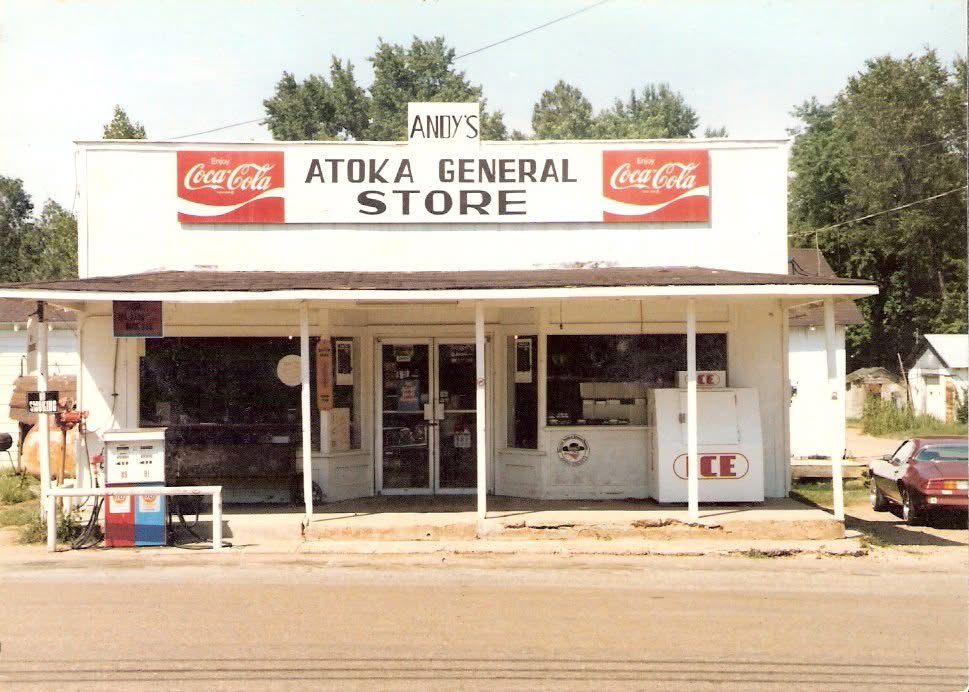
correction — I’d love to hear it. I shared some of these stories on the Atoka General Store Facebook page. The remembering is better when it’s shared.
Preserving the past. Sharing the present. Growing the future.
Sources and Records
I try to show my work. Here is where the facts in this story come from.
Atoka Charters
Town charters — Acts of Tennessee. Atoka’s legal roots are in the state’s own law books. The
incorporation act recorded as Private Acts of 1837-38, Chapter 295, page 432, and the charter the town operated under for a long time is Chapter 373 of the Private Acts of 1911 (House Bill 647, June 24, 1911). University of Tennessee’s Municipal Technical Advisory Service (MTAS) municipal data and the Tennessee Blue Book tracked these.
One honest wrinkle: published timelines drawn from the Covington Leader give January 17, 1838 for Portersville’s incorporation, while MTAS lists November 1, 1838. The act itself is the record that settles it. This article contains a copy of the original charter.
The 1875 name change, the 1883 repeal, and the 1911 reincorporation all come from this same charter record trail, as compiled in “Atoka, Tennessee,” Wikipedia: https://en.wikipedia.org/wiki/Atoka,_Tennessee — MTAS Atoka page: https://www.mtas.tennessee.edu/directories/cities/atoka.
The 1838 Portersville Charter information came directly from:
Vince McGrath | Legislative History Coordinator, Tennessee State Library and Archives, from an email on August 04, 2026.
Note: Stephanie Bohrman did much of the research on Atoka’s charters listed on Wikipedia. She no longer contributes to Wikipedia. Please check the sources when researching using Wikipedia.
Homecoming ’86 & Atoka History Book
Homecoming ’86. Atoka marked Tennessee Homecoming ’86 with a published town history,
Welcome Home Atoka! A History of Our Town, edited by Tim Forbess (Atoka, 1986, 92 pages), listed in the Tennessee Secretary of State’s Tipton County bibliography:
http://sos.tn.gov/tsla/pages/genealogical-fact-sheets-about-tipton-county — Adkison Park was also established as a Homecoming ’86 project.
My Memories
Not from records at all:
My own memories in this article, Homecoming ’86, and the family information a relative gave me later are family history, and they’re labeled as such.
Origin of the Name Atoka
The name. “Atoka” derives from the Choctaw word hitoka (also spelled hetoka), meaning “ball
ground,” the stickball field — see the Choctaw Nation’s “Choctaw Place Names in Okla Humma”:
https://www.choctawnation.com/news/iti-fabvssa/choctaw-place-names-in-oklahumma/ and the Great River Road guide above, which says Tennessee’s founders selected the word as the new town’s name.
Captain Atoka Oshlatubee, the Choctaw leader whose name came from the same word, is documented as the namesake of Atoka, Oklahoma (U.S. Bureau of Reclamation, McGee Creek Project history; “Atoka, Oklahoma,” Wikipedia: https://en.wikipedia.org/wiki/Atoka,_Oklahoma).
The Tipton County genealogy notes at https://www.boydroots.net/Places/tennessee.html repeat the namesake story for our Atoka in the same words as the Oklahoma account, so I have treated it as handed-down tradition rather than settled fact, and I have given no birth or death dates for Captain Atoka, because the sources disagree about them.
Population Figures
Population — U.S. Census. The figures used here (659 in 1990, 8,387 in 2010, 10,008 in 2020) are federal decennial census counts, also published in U.S. Census Bureau QuickFacts for Atoka town, Tennessee:
https://www.census.gov/quickfacts/fact/table/atokatowntennessee,TN,US/MAN450212
Portersville and Early Atoka
Portersville and Early Atoka — Goodspeed’s History of Tennessee (1887). Goodspeed’s Tipton
County history was published while people who lived this story were still alive to tell it. Its
biography of John McLaughlin — born in Ireland, landed at Charleston, learned the carriage maker’s trade at Chester, South Carolina, sold goods at Portersville, then moved his business to Atoka — documents both the Irish-by-way-of-Chester settlement pattern and the Portersville-to-Atoka move in one man’s life. (Transcriptions:
https://www.genealogytrails.com/tenn/tipton/biographies_m.html)
Railroad History
The railroad. The 1872 arrival of the Memphis and Paducah Railroad, the town laid out on Hugh Thompson’s land between Mt. Zion and Portersville, and Atoka’s role as the shipping point for local cotton and lumber are described in the Great River Road visitor guide to Atoka:
https://www.greatriverroad.com/atoka-tn — Atoka’s place on the line in 1888 is documented by a railroad map of that year showing the Newport News & Mississippi Valley Railroad running through Tipton County.
The Rivalry
The rivalry — the Covington Leader. The account of Portersville’s rivalry with Atoka after the
railroad came in 1872 comes from the Covington Leader’s fiftieth-anniversary history (1886–1936), quoted in the Wikipedia article above. Tennessee newspapers, the Leader among them, are held on microfilm at the Tennessee State Library and Archives in Nashville.
United States Postal Service by Rail
The complete “Post Route Map of the State of Tennessee Showing Post Offices … September 15, 1944” can be found on the David Rumsey Map Collection website – https://davidrumsey.oldmapsonline.org/maps/f01bea1b-398a-4c15-bc07-98e3df2fbfbc/.